Mirko Czentovic
The Royal GameMirko Czentovic is a world chess champion whose extraordinary success rests on a sharply bounded kind of intelligence: he dominates the visible board while remaining unable to play a game in his head. His journey from a poor boatman’s son to the summit of competitive chess makes him at once an unlikely prodigy and a figure of rigid, commercially minded pride. On a voyage from New York to Buenos Aires, that pride is tested when an unknown opponent defeats him in a fair contest.
Identity and Background
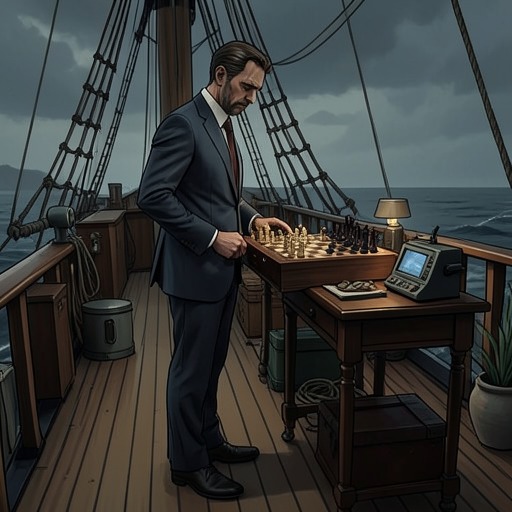
Czentovic is introduced aboard a large steamship bound for Buenos Aires, where reporters crowd around him shortly before departure. A friend identifies him as the world champion, returning from a tour of the United States and heading for new conquests in Argentina. His fame is recent but immense: about a year earlier, he had abruptly joined the established masters, in a sensation compared to the appearance of the seven-year-old Reshevsky at the 1922 New York Masters.
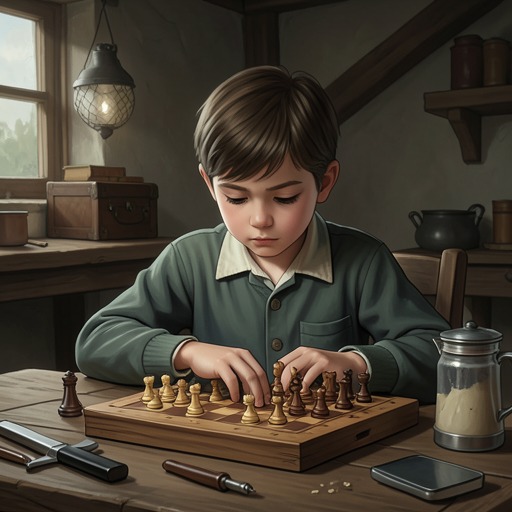
His public achievement contrasts starkly with the account of his education and abilities away from chess. The son of a desperately poor boatman on the middle Danube, he loses his father at twelve, when a grain freighter runs over the family’s small coracle. The priest of their remote hamlet takes the boy in and tries to teach him, but Czentovic struggles to retain even the alphabet, uses his fingers for arithmetic at fourteen, and finds reading a book or newspaper unusually difficult. He is not described as defiant: he obeys instructions and completes household and farm tasks, though slowly. The account instead emphasizes his apathy and lack of initiative, setting the stage for the disjunction between his limited general education and his exceptional chess results.
Chess Ability and Rise
A local player first notices Czentovic’s chess talent by chance. After the priest and a friend begin a game, the friend is called away; Czentovic, who has been watching, takes his place and wins. The priest initially suspects an accident, but a second game ends the same way. A neighboring schoolmaster then tests him and confirms that the ability is real. Under further instruction, Czentovic rapidly acquires chess technique, and after six months he has mastered enough to enter the competitive world.
His gift has a defining limitation: he cannot play blind, or reconstruct a position without a physical board. Even at the height of his fame, he carries a folding pocket chessboard to examine positions and work through problems. This dependence on the board makes his strength seem less like an expansive power of imagination than a formidable command of what is directly laid out before him. Yet it does not impede his results. He wins a dozen prizes by seventeen, takes the Hungarian championship at eighteen, and becomes world champion at twenty. More intellectually daring grandmasters repeatedly succumb to his cold, tenacious logic.
Fame, Money, and Manner
Czentovic’s tournament standing brings him symbolic prestige, but the account presents him as keen to convert that prestige into money. He travels wherever a fee is guaranteed, stays in the cheapest hotels, plays at poor clubs, and permits his name to appear in soap advertisements. He also lends it to a book titled Philosophy of Chess, although a Galician student has actually written the work. These examples make his commercial instinct part of his public identity rather than an incidental detail.
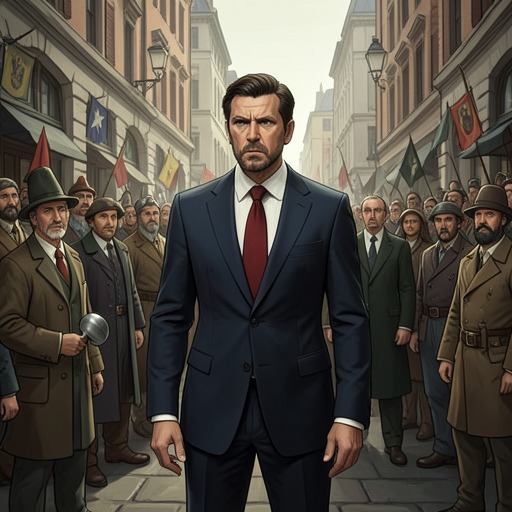
The narrator’s account also stresses the comic contrast between Czentovic’s authority at the board and his bearing away from it. In a smart black suit, a conspicuous cravat pin, and carefully manicured fingers, he nevertheless retains the awkward manners attributed to the farm boy who once swept the priest’s kitchen. His colleagues find his greed both amusing and infuriating. Success and earnings, the account suggests, turn his early lack of confidence into cold, unconcealed pride: he regards himself as the most important man in the world because he has beaten celebrated intellectuals at their own game and makes more money than they do.
The Shipboard Matches
When a group of chess-playing passengers arranges a game, Czentovic makes them wait ten minutes before appearing. He offers practical terms without introducing himself or showing interest in the players: lacking enough boards for a simultaneous match, he will play the group collectively, moving from table to table while they discuss their responses. The players accept his arrangements, including a ten-minute limit for each move. Czentovic takes Black and, after answering their first move, goes to another part of the room to leaf through an illustrated magazine.
The first match ends in the predictable defeat of the amateurs after twenty-four moves, but the manner of victory sharpens the encounter. Czentovic gives their boards only cursory attention, looks past them as though they were inanimate, and offers neither advice nor encouragement. After saying mate, he falls silent. His performance makes the difference between chess competence and social generosity unmistakable: he need not humiliate the players, but he allows his effortless superiority to become the point of the exercise.
Defeat and Narrative Significance
In a subsequent game, Czentovic faces an opponent whose announced move leaves the amateur spectators unable to see any immediate threat. The champion remains motionless through a long, tense wait. Then he lifts his hand and sweeps the pieces off the board rather than making a move. He has capitulated to avoid being checkmated. The victory is startling not only because Czentovic is the world champion, but because his opponent is an unknown who has not touched a chessboard for twenty or twenty-five years.
The spectators rise in astonishment, while Czentovic remains seated and then looks stonily at the victor. His brief question, “Another game?” refuses any outward display of defeat. The reversal exposes the limit of his previously unchallenged authority: the player who had treated the amateurs as negligible is himself overcome by someone whose ability falls outside the ordinary expectations of the shipboard group. Czentovic’s characterization depends on this contrast between mastery and limitation, public triumph and narrowness, and competitive composure and the moment when the board no longer yields him a winning move.